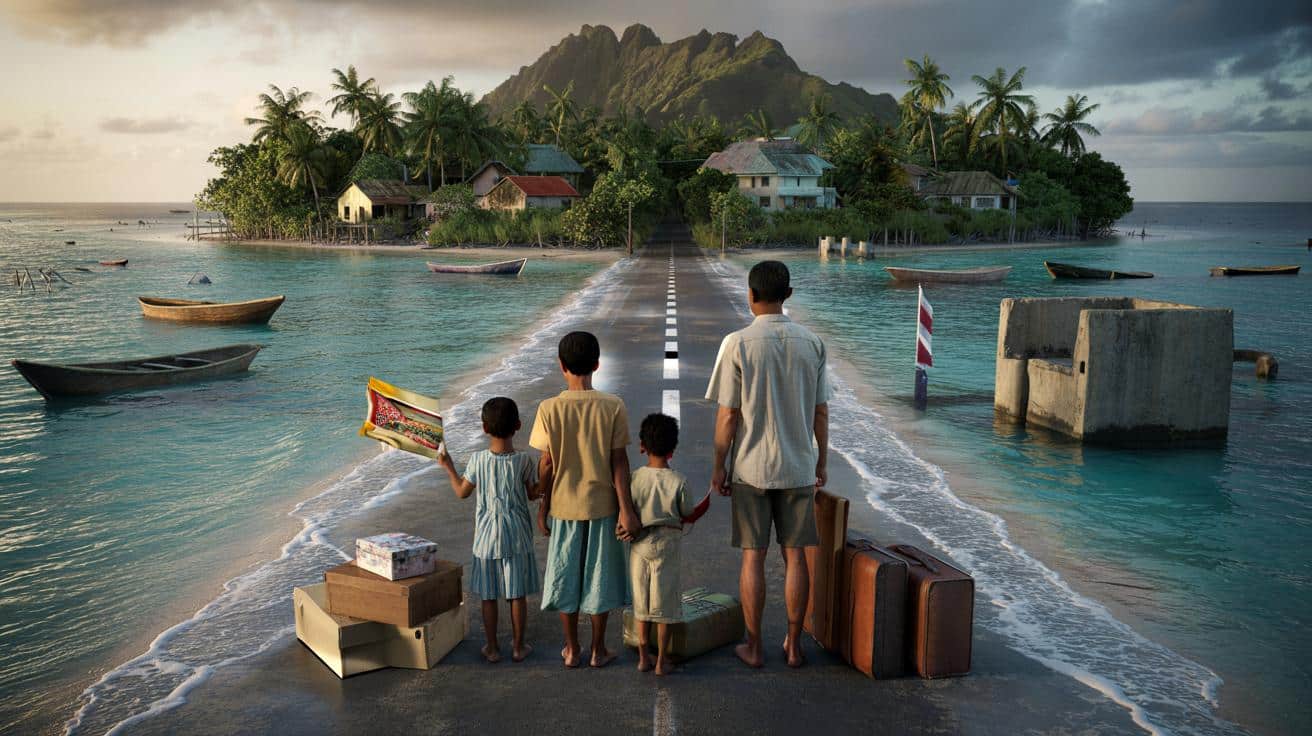
Tuvalu, a postcard-perfect atoll nation spread across nine low-lying islands, is now drawing up a plan that no country has ever had to make: how to move almost its entire population abroad while keeping its identity, its statehood and even its memories alive.
When a country starts to sink
Tuvalu sits only a few metres above sea level at its highest points. That used to be a quirk of geography. With climate change, it has become a threat to the nation’s survival.
According to NASA’s Sea Level Change team, average sea levels around Tuvalu are now roughly 15 centimetres higher than they were over the past three decades. On a concrete sea wall that may not sound like much. On a strip of sand barely wider than a motorway, that rise is life-changing.
Rising water is already pushing salt into wells, flooding homes during king tides and putting Tuvalu’s only airport and freshwater supplies at risk.
Storms that once felt exceptional now hit harder and more often. Higher seas give cyclones more power to push waves inland. Floodwaters wash through homes and crop fields. Traditional wells turn brackish. Cement foundations crack as coastlines erode beneath them.
For Tuvaluans, this is not just a technical issue about centimetres and degrees. It is about losing an entire way of life rooted in the ocean, village kinship and a spiritual connection to land that has been passed down for generations.
Each time the sea bites further into the shore, burial grounds edge closer to the waves. Fruit trees that fed families for decades die from salt poisoning. The prospect of leaving stops being a distant nightmare and becomes part of everyday conversation.
The world’s first “climate visa” deal
In late 2023, Tuvalu and Australia signed a landmark agreement called the Falepili Union. Behind the technocratic name lies a radically new idea: climate migration managed as a deliberate state policy, not as a last-minute emergency.
Under the deal, Australia will create a dedicated pathway for Tuvalu citizens to settle there, with up to 280 people allowed to move each year. That number sounds small, but for a nation of about 11,000 inhabitants, it amounts to the gradual relocation of a large share of the country over a generation.
➡️ Why some people feel anxious when everything seems to be going well
➡️ How a single bedroom houseplant can increase deep sleep phases by 37%, according to a new nasa study
➡️ Brits are slashing winter bills by 20% with a grandma’s heating trick: are you wasting £150?
➡️ How structuring the day around habits improves efficiency
➡️ The psychology behind emotional burnout without obvious causes
➡️ As it drifts away from Earth, the Moon is quietly stretching our days and softening our tides
The programme offers Tuvaluans access to healthcare, education and work rights similar to those of permanent residents in Australia.
Rather than selecting only the most educated or wealthiest applicants, the system uses a lottery. In the first round alone, around 8,750 Tuvaluans registered an interest in the visa — more than one third of the population.
That level of demand reflects both fear and agency. Many families see migration as a way to secure schooling, jobs and safety for their children before the situation becomes desperate on the islands. The lottery model is also meant to reduce tensions at home by giving everyone a theoretical chance of leaving.
Why Australia is involved
Australia has long been criticised for its large carbon footprint and its reliance on fossil fuel exports. The Tuvalu deal gives Canberra a way to present itself as a regional protector rather than just a distant polluter.
There are strategic calculations too. Tuvalu sits in a region where big powers, particularly China and the United States, are competing for influence. Offering a lifeline bolsters Australia’s role as the main partner for Pacific states facing climate pressure.
- Australia gains influence in the Pacific and a symbol of climate leadership.
- Tuvalu gets a structured pathway for migration, instead of chaotic emergency evacuations.
- The world receives a test case for handling climate-driven relocation.
Keeping a country alive without land
For Tuvalu’s government, survival is not just about moving people. It is also about proving that a state can continue to exist even if its territory becomes uninhabitable or, in the worst case, completely submerged.
In 2022, Tuvalu launched a digital preservation project that sounds like science fiction but is rapidly becoming policy. Authorities are creating 3D scans of islands, villages and key landmarks so that the nation’s landscapes can be archived and visited in virtual form.
Officials are planning for a “digital state” in which Tuvalu’s institutions could function online long after the physical territory is lost.
This project is not just a sentimental archive. It could serve a legal purpose. International law usually assumes that a state needs a defined territory. Tuvalu wants to challenge that by maintaining a government, citizenship registry and even a virtual parliament, all hosted on foreign servers if needed.
The idea is that a Tuvaluan government in exile, supported by host countries, could continue to hold a UN seat, issue passports, manage fishing rights over its vast ocean zone and protect its cultural heritage.
Culture on the move
Tuvaluan culture is tightly woven into daily life: communal cooking, church gatherings, lagoon fishing, traditional dances and collective decision-making on village grounds.
If communities scatter across Australian suburbs, that fabric risks fraying. For that reason, Tuvaluan leaders and Pacific scholars argue that relocation programmes need to be designed with Tuvaluans, not just for them.
They want housing that allows extended families to live near each other. They call for schools in Australia to support the Tuvaluan language. They push for community centres where dances, songs and ceremonies can continue, even thousands of miles from the original atolls.
| Challenge | Risk for Tuvaluans | Possible response |
|---|---|---|
| Loss of language | Younger generations switch entirely to English | Language classes and community-run schools |
| Scattered families | Weakened support networks and identity | Grouped resettlement in specific areas |
| Discrimination | Barriers to jobs and housing | Anti-racism policies and targeted employment schemes |
Climate exile as tomorrow’s political reality
Tuvalu’s situation is extreme, but it is not unique. Other atoll nations such as Kiribati and the Marshall Islands face similar pressures. Low-lying coastal areas from Bangladesh to Louisiana are also watching the water inch closer.
What sets Tuvalu apart is its decision to treat climate displacement as a national strategy, not a personal tragedy faced by each family on its own. That changes the questions the world has to answer.
If a state loses all dry land but keeps a government and a diaspora, should it still control its maritime zone, with the fish and minerals beneath? Can it still sign treaties? Should other countries be obliged to accept some of its citizens? These debates are only starting, and Tuvalu sits at their centre.
What “climate refugee” really means
The term “climate refugee” often appears in headlines, but in legal language it does not exist. The UN Refugee Convention protects people fleeing persecution, not gradual sea-level rise or drought.
Tuvalu’s deal with Australia skirts that gap by using a bespoke visa category instead of trying to rewrite global refugee law. That approach may be faster, but it depends on politics and goodwill. If governments change, so can the terms of these visas.
For people on the ground, the labels matter less than the outcomes: a safe home, a stable income and the ability to keep a sense of who they are.
Scenarios for Tuvalu’s future
Several broad scenarios are now discussed in Pacific policy circles. None feels comfortable, but all are being treated as realistic.
- Managed dispersal: Tuvaluans gradually move to Australia and other countries under planned programmes, while a smaller population tries to remain on the islands as long as possible.
- Digital nationhood: If parts of Tuvalu become uninhabitable, the government continues online, and the diaspora maintains a strong political and cultural identity.
- Territorial loss: In the worst case of full submergence, Tuvalu’s legal battle would focus on keeping its seat at international bodies and its maritime rights despite having no dry land at all.
Each scenario comes with cumulative pressures: mental health strains from leaving ancestral homes, financial burdens of starting again abroad, and political friction in host countries already facing housing and cost-of-living crises.
Yet there are also potential benefits if the transition is handled carefully. Tuvaluan communities could gain access to better healthcare and education while building influential diasporas that lobby for stronger climate action. Their experience may guide other vulnerable regions in planning ahead rather than waiting for disaster.
On a warming planet, Tuvalu’s story is not a distant curiosity. It is an early case study in what happens when the abstract graphs of climate science cut into the map of nations and redraw it, line by line, shoreline by shoreline.