Our planet was still finding its balance when a giant asteroid, far larger than the one that wiped out the dinosaurs, struck with unimaginable force. New research now sheds light on how this ancient impact nearly turned Earth into a hellscape – and strangely helped life get a second wind.
A monster rock from the early solar system
The asteroid is known as S2, a rather modest name for such a terrifying object. It was first identified not by a crater you can see on the surface today, but by chemical traces found in extremely old rocks in Western Australia and South Africa.
These rocks date back roughly 3.2 billion years, a time when Earth looked nothing like the planet we know. There were no trees, no animals, no continents as we imagine them now. The surface was dominated by oceans and scattered proto-continents, and life consisted almost entirely of microscopic single-celled organisms.
According to a study published in Proceedings of the National Academy of Sciences in October 2024, S2 was truly enormous. Researchers estimate its diameter between 40 and 60 kilometres – making it tens to hundreds of times more massive than the asteroid that ended the age of dinosaurs 66 million years ago.
S2 was so large that the dinosaur-killer looks small by comparison, more like a stone than a planet-shaping weapon.
For a rough visual, imagine Paris, then double it. Now picture that entire volume made of solid rock and metal, hitting Earth at tens of thousands of miles per hour. The energy released would have dwarfed any volcanic eruption or earthquake in human history.
A blow that shook half the planet
From the geological clues, scientists estimate that S2 carved out a crater around 500 kilometres wide. That is big enough to stretch from London to Paris, or from New York to Pittsburgh.
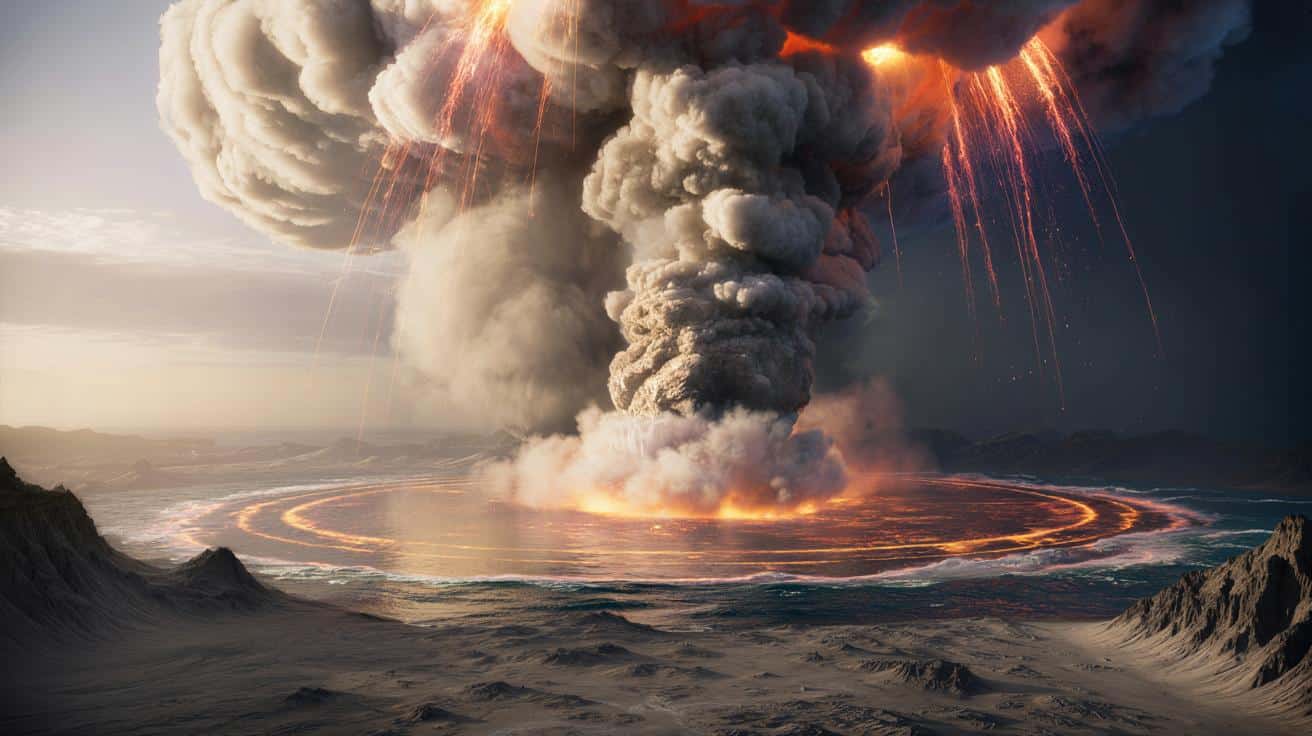
The immediate blast would have vaporised rock at the impact site, hurling molten material high into the atmosphere and even into space. This glowing debris then rained back down over vast distances.
Think of a thunderstorm cloud, but instead of raindrops, the sky is filled with red-hot rocks falling everywhere.
➡️ How a single bedroom houseplant can increase deep sleep phases by 37%, according to a new nasa study
➡️ How structuring the day around habits improves efficiency
➡️ Brits are slashing winter bills by 20% with a grandma’s heating trick: are you wasting £150?
➡️ As it drifts away from Earth, the Moon is quietly stretching our days and softening our tides
➡️ For the first time, an entire nation is preparing to be evacuated because of global warming
➡️ The psychology behind emotional burnout without obvious causes
That fiery “rain” was only part of the story. The shockwave racing through the oceans would have triggered mega-tsunamis, likely thousands of metres high in the impact region, sweeping across the scattered early continents and coastlines.
The oceans themselves took a brutal hit. The study suggests that the energy released was enough to heat and partially boil the upper layers of seawater. Tens of metres of ocean depth may have evaporated in some regions.
The steam blasted into the atmosphere, trapping heat and driving surface temperatures towards 100°C in places. For a time, much of Earth could have felt like a vast, scalding sauna rather than a blue planet.
- Estimated asteroid size: 40–60 km in diameter
- Crater size: around 500 km across
- Surface temperatures: up to ~100°C near the surface
- Main effects: molten rock rain, mega-tsunamis, atmospheric dust and steam, ocean evaporation
Life under attack – and then a surprise twist
At that time, life was confined to the oceans and consisted largely of bacteria and archaea. Many of them relied on sunlight for energy, using primitive photosynthesis in shallow waters close to the surface.
S2’s impact threw vast quantities of dust, ash and vaporised rock high into the atmosphere. This debris formed a global shroud, blocking sunlight for a long period. Photosynthetic microbes suddenly lost their main energy source.
For them, the aftermath was deadly. Without sunlight, their ecosystems must have crashed. In biological terms, this event was a massive stress test for early life.
But deep in the oceans, far from sunlight, another kind of microbe may have found an opportunity. Many bacteria use chemical reactions rather than light to power themselves. For these organisms, the S2 impact turned out to be a windfall.
The collision released huge amounts of nutrients such as phosphorus and iron into the seas, feeding the microbes that relied on chemistry, not sunlight.
As rock was pulverised and altered by heat, key elements were washed into the oceans. These nutrients are vital for building DNA, cell membranes and proteins. With more of them around, some microbial communities could grow faster and colonise new niches.
The researchers see signs in ancient rocks that life did not just cling on – it bounced back quickly and diversified. What looks like a planet-wide disaster may, over time, have helped drive evolution forward.
How scientists track a vanished crater
The original S2 crater is long gone. Plate tectonics, erosion and volcanic activity have completely reworked Earth’s surface over billions of years. So how do we know such an impact happened at all?
Geologists rely on tiny clues preserved in ancient rocks. They hunt for layers filled with small, rounded beads of rock called spherules. These form when molten droplets from an impact cool rapidly as they fall back through the atmosphere.
In Western Australia and South Africa, some of the oldest surviving sediments on Earth contain thick layers rich in these spherules. Their chemistry and structure match what you would expect from a massive asteroid strike.
| Clue | What it tells scientists |
|---|---|
| Impact spherules | Evidence of molten rock droplets from a huge collision |
| Metal ratios (e.g. iridium) | Signature of extraterrestrial material mixed into Earth rocks |
| Shock features in minerals | Minerals deformed only under extreme pressures from impacts |
| Dating of rock layers | Places the impact at around 3.2 billion years ago |
By combining these clues with computer simulations of asteroid impacts, researchers can estimate the size, speed and angle of S2. The numbers all point towards one of the most violent events in our planet’s recorded geological history.
Why this ancient impact matters today
This research changes how scientists think about early Earth. The planet was not just a calm, warm ocean world where life slowly blossomed. Instead, it was regularly battered by enormous rocks, each one capable of rewriting the rules for survival.
For astrobiologists, S2 offers a powerful case study. It shows that life can survive extreme shocks, provided there are refuges – such as deep oceans or underground habitats – where conditions stay relatively stable.
That has direct implications for the search for life on other worlds. A young exoplanet that has been hit by a big asteroid is not necessarily dead. If it has liquid water and protective environments, microbes could be hiding out, waiting for conditions to improve.
Key terms that help make sense of the story
When reading about events this ancient, a few technical terms come up again and again. A short guide helps put them in context:
- Archean eon: The period from about 4 billion to 2.5 billion years ago, when Earth’s crust cooled and the first long-lasting continents appeared.
- Photosynthesis: A process used by some microbes and plants to turn light, water and carbon dioxide into energy and oxygen.
- Chemosynthesis: A way of getting energy from chemical reactions, often used by microbes living around deep-sea vents or underground.
- Impact spherules: Tiny glassy beads formed when rocks are vaporised by an impact and then cool as they fall back through the air.
Could something like S2 happen again?
A strike on the scale of S2 is extremely rare. Events that large are thought to occur only a handful of times over the entire 4.5‑billion‑year history of Earth. On human timescales, the risk is tiny.
Modern asteroid surveys focus on objects a few kilometres across, which are far smaller than S2 but still dangerous for civilisation. Space agencies track these near-Earth objects and test planetary defence strategies, such as missions that nudge an asteroid off course.
Running simulations of giant ancient impacts also helps scientists understand what would happen if a large rock did slip through. They model tsunamis, global fires, atmospheric dust and climate shifts. These scenarios feed into risk planning, even though an S2-scale blow is far beyond what we expect in the foreseeable future.
Viewed across billions of years, S2 highlights a strange pattern in Earth’s history: the same cosmic violence that nearly sterilised the planet may have provided the raw materials and the shake-up needed for life to adapt, innovate and eventually lead to us asking how it all began.