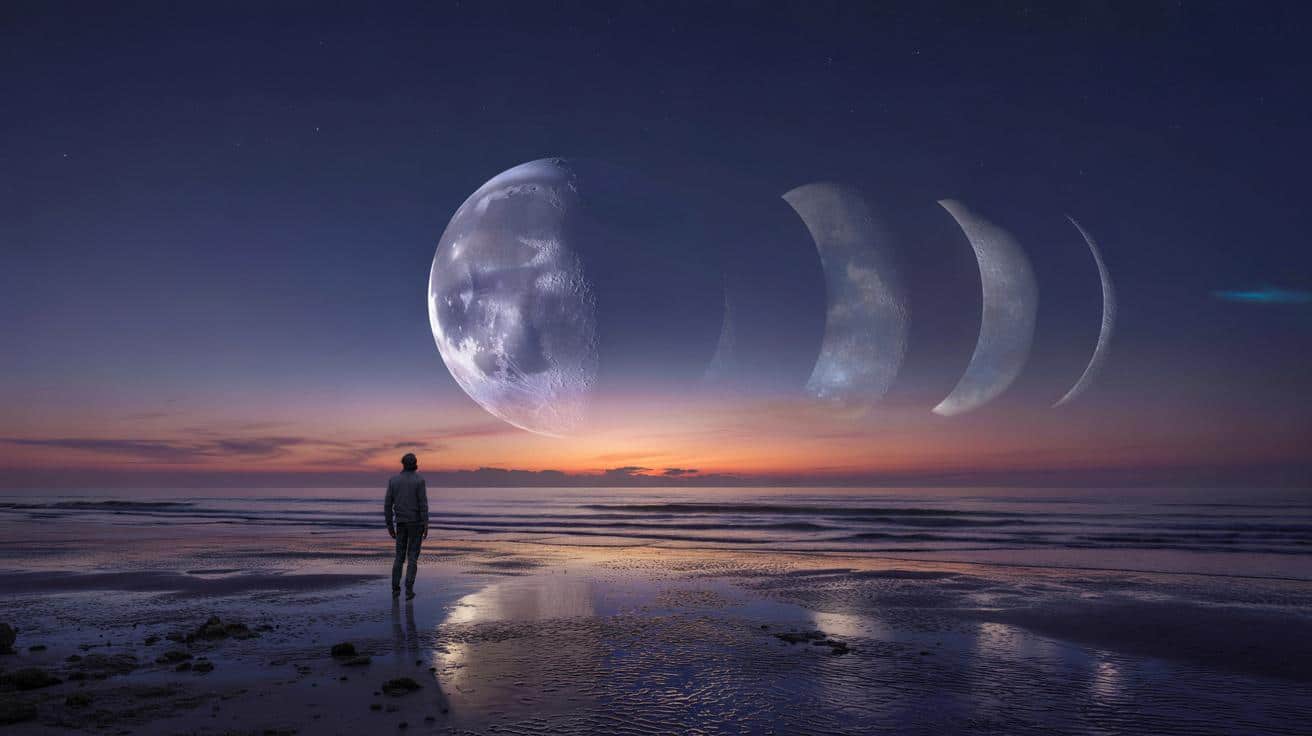
The Moon’s orbit is widening by a few centimetres each year, and that tiny shift is quietly rewriting the length of our days and the power of our tides over geological time.
The Moon used to loom much larger in our sky
If you could stand on a beach 70 million years ago, at the end of the age of dinosaurs, you would see a very different Moon. It would shine bigger and brighter, hanging slightly closer to the horizon, and the tides at your feet would surge with more force than they do today.
Back then, a day on Earth lasted around 23.5 hours. The planet spun a little faster, squeezing more rotations into a year. Scientists can tell thanks to an unusual natural timekeeper: fossil seashells. Some ancient bivalves laid down microscopic daily growth bands as they built their shells. By counting and measuring those bands, researchers have calculated that an ancient year contained about 372 separate day–night cycles.
That means the year itself wasn’t shorter, but each day was. The most straightforward explanation is gravitational: the Moon was closer, its pull on Earth’s oceans stronger, and its braking effect on our rotation higher.
Far in the past, a shorter day was the direct consequence of a nearer, more domineering Moon.
A violent origin story
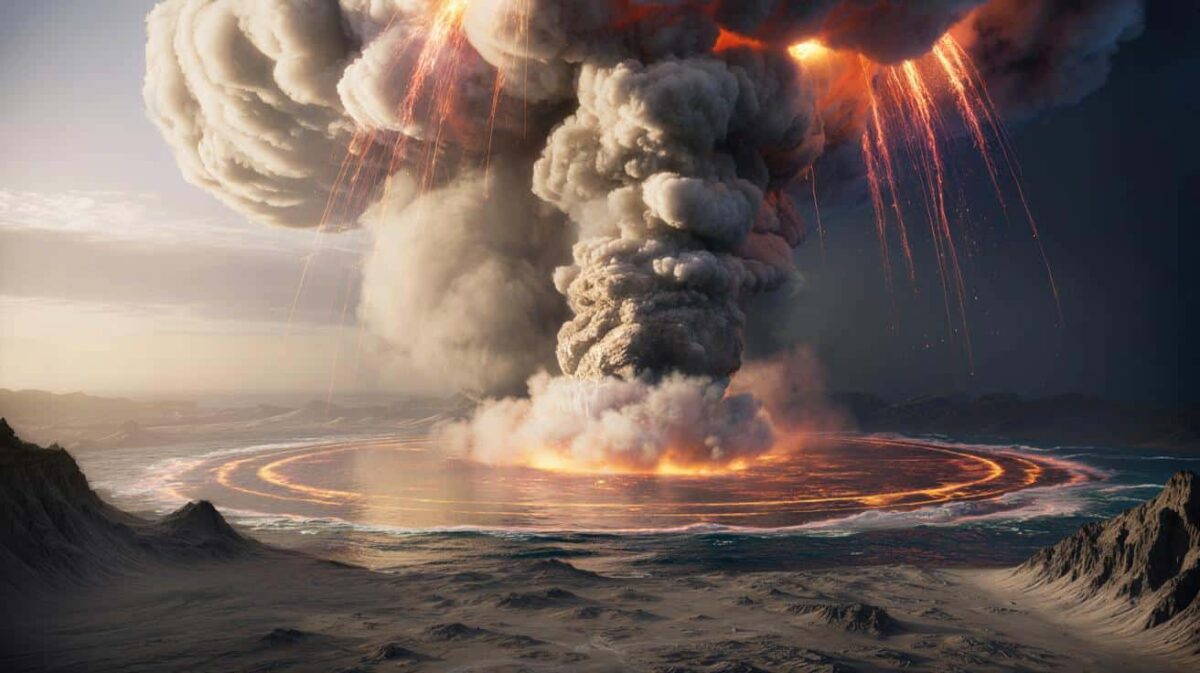
The drifting we see today traces back to a catastrophic beginning. Around 4.5 billion years ago, a Mars-sized body is thought to have smashed into the young Earth. The collision blasted molten rock into orbit. Those glowing fragments eventually clumped together to form the Moon.
Early on, the new Moon hugged our planet. In the night sky it would have looked enormous, perhaps several times its current apparent size. That closeness unleashed dramatic tides. Vast tidal bulges rolled across still-forming oceans and shallow seas, churning the coastlines and pumping energy between Earth and its new satellite.
How tides push the Moon away, millimetre by millimetre
Today, that same tidal dance continues, just at a calmer pace. Earth spins once every 24 hours, while the Moon orbits us roughly every 27 days. Because Earth rotates faster than the Moon moves around it, the tidal bulges in our oceans get dragged slightly ahead of the Moon’s position in the sky.
This offset matters. The bulges are made of water, but they also contain mass. Their gravity tugs on the Moon, giving it a tiny forward pull in its orbit.
➡️ The psychology behind emotional burnout without obvious causes
➡️ For the first time, an entire nation is preparing to be evacuated because of global warming
➡️ How structuring the day around habits improves efficiency
➡️ Brits are slashing winter bills by 20% with a grandma’s heating trick: are you wasting £150?
➡️ Why some people feel anxious when everything seems to be going well
➡️ 3.2 billion years ago, an asteroid twice the size of Paris plunged Earth into chaos
The oceans act like a gravitational slingshot, stealing a little rotational energy from Earth and handing it to the Moon.
With that extra energy, the Moon climbs to a slightly higher orbit. That is what “moving away” actually means: the orbit is growing. Multiple measurements, especially laser experiments bouncing off mirrors left by Apollo astronauts, show that the distance between Earth and Moon increases by about 3.8 centimetres each year.
Energy is conserved, so something has to give. As the Moon gains orbital energy, Earth loses rotational energy. Our spin slows down. The result is that a day grows longer by roughly a couple of milliseconds per century. It is too small to feel, but accumulates over tens of millions of years.
- Current Moon recession rate: about 3.8 cm per year
- Day lengthening: roughly 2 milliseconds per century
- Days at the end of the dinosaur era: about 23.5 hours
An invisible but relentless process
This slow exchange has been running for billions of years. The rate changes with the layout of the continents, the depth of the oceans and even the presence of ice sheets, because these shape how tides move around the globe. When continents form shallow seas and echoing bays, tides can grow stronger and bleed more rotational energy from the planet.
Researchers treat the Earth–Moon system as a vast, natural clock. By comparing ancient records stored in rocks, corals and shells with physical models, they can reconstruct where the Moon must have been in the past and how fast Earth was turning. The broad trend is always the same: the Moon creeps outward, Earth’s spin eases, and days stretch.
What happens to our days, nights and tides in the far future
If nothing else changed for trillions of years, the process would eventually grind to a halt. Earth’s rotation would slow until one side of our planet always faced the Moon, locked in step. Astronomers call that gravitational lock a “tidal locking” state. We already see it on the Moon itself: the same face always points toward Earth.
In a tidally locked future, one hemisphere would keep a near-constant view of the Moon, while the other barely saw it at all.
At that stage, tides would lose much of their drama. Instead of rolling in and out with the daily cycle, the oceans would form more static bulges, only gently shifting with subtle changes in the system. The energetic, crashing surf that shapes coasts and feeds tidal ecosystems would calm.
Reality, though, is unlikely to reach this neat end-state. Long before full tidal locking, the Sun will intervene. Models suggest that in about a billion years, the Sun’s increasing energy output will drive intense warming on Earth. Seas will gradually evaporate into the atmosphere, stripping away most of the liquid water that fuels tides in the first place.
With no true oceans, the mechanism that pumps the Moon outward largely switches off. The drift slows dramatically. Then, several billion years later, the Sun will swell into a red giant and engulf the inner solar system, likely erasing both Earth and Moon altogether.
Changing eclipses and calmer coasts
On human timescales, the most noticeable shift from lunar recession will come from eclipses and subtle coastal changes. As the Moon moves away, it appears slightly smaller in our sky. At some distant point, it will no longer fully cover the Sun during an eclipse. Future eclipses would tend to be annular, with a ring of sunlight blazing around a dark lunar disc.
We also expect tides to lose a bit of intensity over millions of years. Strong tidal currents that shape estuaries and river mouths could weaken. Coastal ecosystems that rely on regular, forceful flushing of water might adapt or give way to new communities. On shorter timescales, human-driven sea-level rise and coastal engineering will matter far more than Moon drift, but the background trend still exists.
Key terms that help make sense of the Moon’s slow escape
A few scientific concepts sit at the heart of this story and help clarify what is going on.
| Term | Meaning |
|---|---|
| Tidal friction | Internal rubbing and resistance inside Earth as tides move, converting rotational energy into heat and orbital energy for the Moon. |
| Angular momentum | A measure of rotational motion. In the Earth–Moon system, it is shared between Earth’s spin and the Moon’s orbit and tends to stay constant overall. |
| Tidal locking | A situation where one body always shows the same face to another, because its rotation period matches its orbital period. |
These physical ideas are not abstract curiosities. They also govern the behaviour of moons around Jupiter and Saturn, and shape the way exoplanets interact with their stars. Many planets outside our solar system may already be tidally locked, with one hemisphere frozen in endless night and the other baking in constant daylight.
Thinking in deep time: simulations and scenarios
Because the changes are so gradual, scientists rely heavily on computer simulations to see where the Earth–Moon relationship is heading. Models combine physics, past geological evidence and estimates of how continents and oceans might shift. By altering parameters such as ocean depth or the layout of future supercontinents, they can test how sensitive lunar drift is to Earth’s surface conditions.
One recurring theme is that the system responds strongly to shallow seas and resonant ocean basins. A future Earth with a new supercontinent and rimmed inland seas could, for a while, increase tidal friction and slightly accelerate the Moon’s retreat. A planet dominated by one deep global ocean might slow it down.
For readers, one useful mental image is a child on a playground swing. Earth is the parent pushing the swing; the Moon is the child. Each push—each tidal cycle—adds a touch of energy, sending the child a bit higher. Over unimaginably many “pushes”, the arc of the swing slowly widens, just as the Moon’s orbit slowly expands.
This steady pull has shaped our history: from the length of a day that ancient organisms adapted to, to the tides that helped life move from sea to land. As the Moon continues to drift, it will keep rewriting the timetable of Earth, long after our own species has gone.