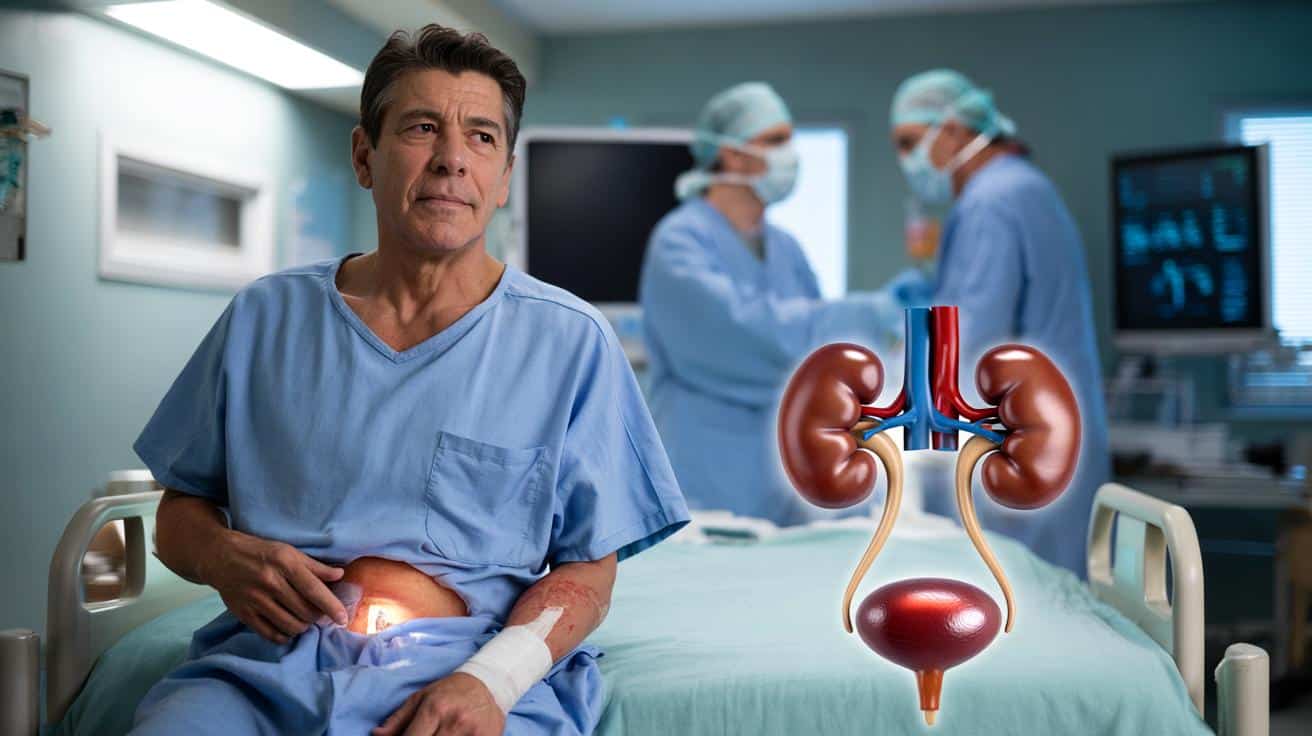
In early May 2025, surgeons at UCLA attempted something many specialists had long written off as unrealistic: transplanting not only a kidney, but an entire donor bladder into a 41‑year‑old man whose urinary system had been almost completely destroyed by cancer.
A life on hold after cancer surgery
The patient, Oscar Larrainzar, had already survived one battle. An aggressive cancer had forced doctors to remove both his kidneys and most of his bladder years earlier. He stayed alive thanks to dialysis, three times a week, every week.
Dialysis replaces some kidney functions, but it does not give back a normal life. Sessions can last hours, leave patients exhausted, and drastically restrict work, travel and social plans. For Oscar, there was no working bladder left to connect a future kidney transplant to.
Standard options for people without a bladder are far from perfect. Surgeons can create a “new” bladder from a piece of intestine, or divert urine to an opening in the abdomen that drains into an external bag.
- Intestinal bladder reconstructions can leak or become infected.
- External urine bags may smell, irritate the skin and affect self‑image.
- Both options often require repeat procedures over the years.
Oscar had reached the point where conventional solutions were exhausted. That made him a rare candidate for an operation that, until 2025, only existed in animal studies and theoretical discussions.
For the first time, a human received a donor bladder and kidney in a single transplant designed to restore a near‑normal urinary cycle.
A world‑first transplant in Los Angeles
The operation took place on 4 May 2025 at the Ronald Reagan UCLA Medical Center in Los Angeles. The surgical team was led by urologist and researcher Dr Nima Nassiri, who had spent years developing the procedure on the lab bench and in preclinical models.
They staged the operation in two major steps. First came the kidney transplant. That part followed a familiar pattern: the donor kidney was connected to Oscar’s blood vessels and to his circulation so that it could start filtering waste from his blood.
Then came the part no one had ever attempted in a human before: connecting a donor bladder inside the pelvis and hooking it up to the newly transplanted kidney.
➡️ How structuring the day around habits improves efficiency
➡️ As it drifts away from Earth, the Moon is quietly stretching our days and softening our tides
➡️ Brits are slashing winter bills by 20% with a grandma’s heating trick: are you wasting £150?
➡️ The psychology behind emotional burnout without obvious causes
➡️ Why some people feel anxious when everything seems to be going well
➡️ For the first time, an entire nation is preparing to be evacuated because of global warming
➡️ How a single bedroom houseplant can increase deep sleep phases by 37%, according to a new nasa study
➡️ 3.2 billion years ago, an asteroid twice the size of Paris plunged Earth into chaos
Within the eight‑hour operation, the new kidney began producing urine, and the transplanted bladder accepted and expelled it without blockage, allowing doctors to stop dialysis immediately.
Surgeons had to reconstruct a dense web of blood vessels in the pelvis to keep the bladder alive. This region of the body is crowded with arteries and veins, and any mistake can cause catastrophic bleeding or organ failure. That complexity is exactly what had discouraged previous attempts at bladder transplantation.
Why UCLA was able to attempt it
One factor played in the team’s favour: at UCLA, the kidney transplant programme is run within the urology department rather than as a separate speciality.
This organisational choice may sound administrative, but it changes how care is delivered. Specialists in kidneys, bladders and urinary reconstruction work side by side, share meetings and follow patients together from preparation to long‑term follow‑up.
For a procedure that required kidney transplant skills, advanced pelvic surgery, vascular reconstruction and post‑operative intensive care, that integrated model allowed faster decision‑making and smoother coordination in the operating theatre.
Why bladder transplants are so rare
Until this case, surgeons had talked about bladder transplants mostly as a thought experiment for medical conferences. The technical hurdles are daunting.
| Challenge | Why it matters |
|---|---|
| Complex blood supply | Multiple small pelvic vessels must be reconnected precisely to keep the bladder alive. |
| Nerve connections | Bladder control depends on a delicate network of nerves that are almost impossible to reattach. |
| Infection risk | The urinary tract is not sterile, increasing the danger of infection at the graft site. |
| Immunosuppression | Patients need powerful drugs for life, which bring their own complications. |
Animal studies had shown that transplanted bladders could survive when blood flow was restored, but long‑term function in humans was still an open question. Would the organ store urine properly without its original nerves? Would leakage or painful spasms appear months later?
Those uncertainties kept many teams from proposing the operation, especially when other, better‑known solutions like intestinal bladders were available.
A cautious new hope for severe urinary disease
For Oscar, the early outcome has been dramatic. After seven years of relying on machines to filter his blood, he could produce urine again through a bladder that sits inside his body rather than in a bag attached to his skin.
His case, though, cannot be treated as an instant green light for thousands of similar surgeries. The transplanted bladder was not connected to its original nerves, so its long‑term continence remains uncertain.
Without nerve reconnection, the bladder may store urine but still need catheters or manual techniques to empty safely and on time.
On top of that, Oscar will need life‑long immunosuppressive medication to stop his body from rejecting both the kidney and the bladder. These drugs lower the immune system’s defences, which can lead to:
- More frequent and severe infections
- Weight gain, diabetes or high blood pressure
- Higher risk of some cancers reappearing or developing
The UCLA team plans to follow him for years and include more carefully selected patients in future trials. Only with that data will doctors be able to judge who might benefit enough from a bladder transplant to justify the risks.
Who might one day be a candidate?
Specialists sketch out a narrow group of people who could be considered if ongoing research confirms good outcomes:
- Patients with irreversible bladder damage from cancer surgery or radiation
- People whose bladders have been destroyed by severe trauma
- Cases where multiple reconstructions with intestine have failed or are impossible
- Patients already needing a kidney transplant at the same time
Even within those groups, the decision would likely be reserved for those who have run out of alternatives, are fit enough for long, complex surgery, and understand the demands of lifelong immunosuppression.
Key terms behind the headlines
For anyone trying to follow this story, some medical vocabulary can feel opaque. Two expressions keep coming up in this case.
Immunosuppressants are drugs that intentionally weaken the immune system so it does not attack transplanted organs. Patients must take them every day, at precise times, and attend regular blood tests to adjust doses. Missing tablets can quickly trigger organ rejection.
Dialysis is a treatment that replaces part of kidney function. Blood is taken from the body, cleaned through a machine or a special fluid, then returned. While life‑saving, dialysis ties people to treatment centres and can bring complications like fatigue, cramps and low blood pressure. A successful kidney transplant, whenever possible, usually offers a better quality of life than long‑term dialysis.
What this could mean for future care
If bladder transplantation proves reliable, it might change the conversation between urologists and patients with severe urinary tract damage. Instead of accepting an external bag or repeated intestinal reconstructions as the end of the road, some could discuss a donor organ as a future option.
Health systems would also need to adapt. Allocation rules for donor organs might have to include bladders alongside kidneys, livers and hearts. Surgeons would require specific training in pelvic vascular reconstruction and combined transplants. Transplant centres might invest more in joint kidney‑urology programmes similar to UCLA’s structure.
For now, doctors stress that this is a first case, not a new routine operation. But for one man in Los Angeles, the ability to walk into a bathroom and simply urinate again, after seven years, is a quiet revolution that medicine had long considered out of reach.